


Bigtargetmedia.com – Search engines process billions of queries every day. Each search reflects a question, intention, or problem that someone wants to solve. For marketers, bloggers, and businesses, these queries represent opportunities to reach audiences at the exact moment they need information.
However, discovering the right keywords has become increasingly complex. Traditional research methods relied heavily on manual analysis, spreadsheets, and guesswork. Marketers often spend hours evaluating search volume, competition levels, and related queries.
Today, AI tools for keyword research transform this process by using machine learning algorithms to analyze massive datasets instantly. Instead of manually filtering keywords, artificial intelligence identifies patterns in search behavior, predicts emerging topics, and suggests high-potential keywords.
Think of AI keyword research as a powerful telescope for the SEO universe. Without it, marketers see only a small portion of search opportunities. With AI, they gain a panoramic view of search trends, user intent, and competitive gaps.
This technological shift allows content creators to build strategies based on real behavioral data rather than assumptions.
How Artificial Intelligence Improves Keyword Research
Understanding Search Intent Through AI Analysis
One of the biggest challenges in SEO lies in understanding why people search for specific keywords. Two phrases may look similar but represent completely different intentions.
For example:
- “Best laptop for students” indicates commercial research.
- “How to fix a laptop keyboard” indicates a technical problem.
Traditional keyword tools focused mainly on search volume and competition. AI systems analyze semantic relationships between words, which helps marketers understand search intent more accurately.
When marketers use AI tools for keyword research, they gain insights into four primary intent categories:
- Informational searches
- Navigational searches
- Commercial investigation
- Transactional searches
This understanding allows marketers to create content that aligns precisely with what users expect.
Discovering Hidden Keyword Opportunities
Another advantage of AI-powered keyword research involves discovering long-tail keywords that traditional tools often miss.
Long-tail keywords usually contain three or more words and represent specific user needs. While each keyword may have lower search volume, the combined traffic potential can be substantial.
Artificial intelligence scans search engine databases and detects connections between related queries. The system identifies keyword clusters that represent broader content opportunities.
For example, a marketer researching “social media marketing” might discover related clusters such as:
- AI tools for social media scheduling
- AI tools for content generation
- AI tools for keyword research
Instead of targeting a single keyword, marketers can build an entire content strategy around interconnected search topics.
AI Tools That Transform Keyword Discovery
SEMrush AI Keyword Research Platform

SEMrush has evolved from a traditional SEO tool into a sophisticated platform powered by artificial intelligence. The platform analyzes search trends, competitive domains, and ranking opportunities across millions of keywords.
When marketers explore keywords using SEMrush, the system generates related terms, question-based queries, and semantic keyword groups. These clusters reveal how search engines interpret topic relevance.
For example, a marketer researching “email marketing automation” might discover dozens of related keyword variations that share similar intent. SEMrush organizes these keywords into logical topic groups that support content planning.
Another powerful feature involves competitor analysis. SEMrush identifies keywords that competitors rank for and highlights gaps where new content can capture traffic.
Because of its comprehensive data analysis capabilities, SEMrush often appears among the most powerful AI tools for keyword research used by professional SEO teams.
Ahrefs AI Keyword Explorer
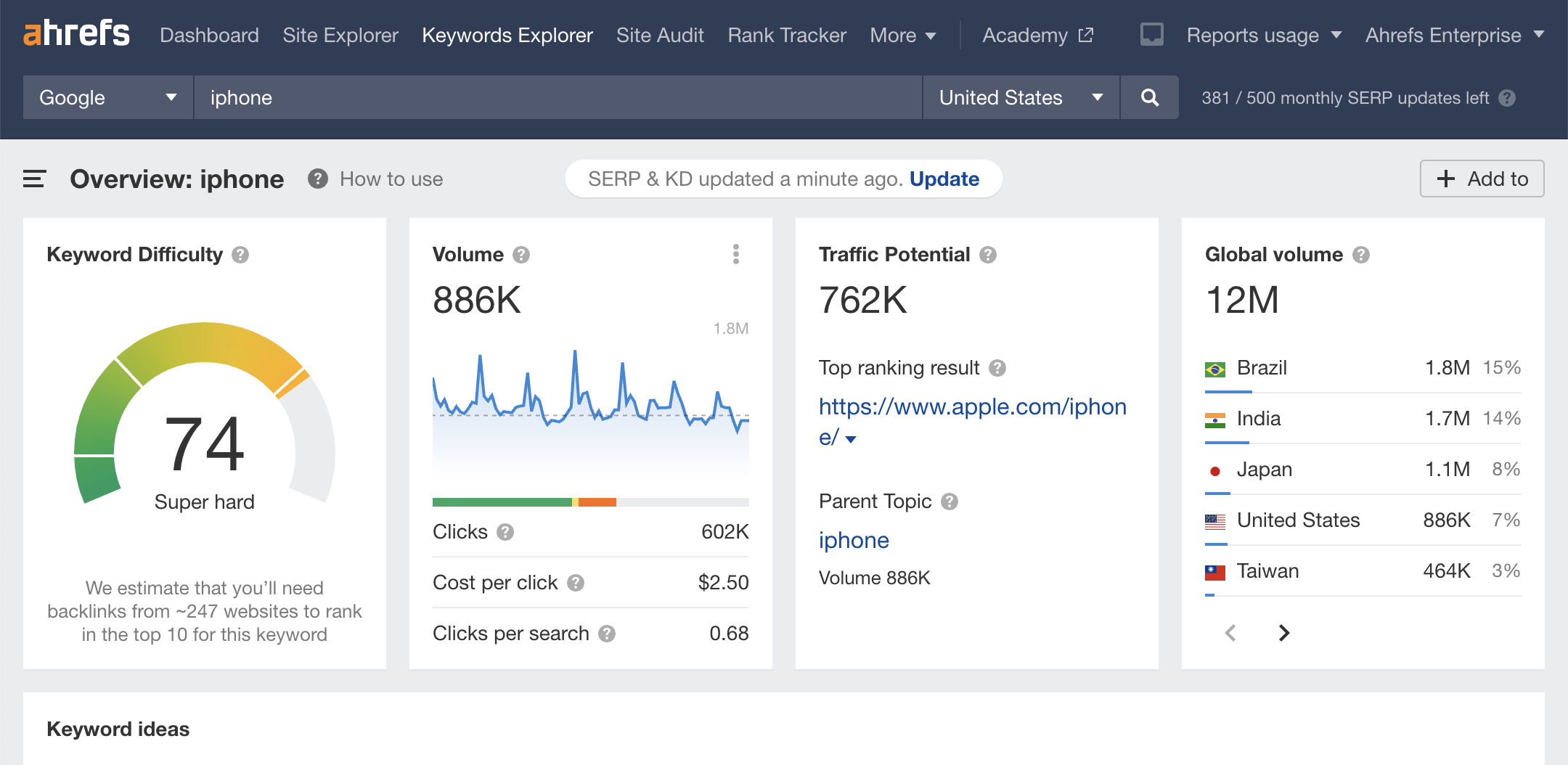
Ahrefs provides one of the most extensive keyword databases available to SEO professionals. Its AI-powered keyword explorer analyzes billions of search queries across multiple countries and languages.
The platform focuses heavily on keyword difficulty analysis. Instead of simply showing search volume, Ahrefs evaluates how challenging it would be to rank for a specific keyword based on current search results.
This insight helps marketers avoid unrealistic targets. For example, a keyword with massive search volume may also have extremely high competition. Ahrefs identifies alternative keywords that offer better ranking opportunities.
Another valuable feature involves click-through data. Some keywords generate many searches but few clicks because search engines display answers directly in results pages. Ahrefs reveals this behavior so marketers can prioritize keywords that actually drive traffic.
Many SEO experts therefore rely on Ahrefs as one of the most effective AI tools for keyword research when building long-term content strategies.
Surfer SEO Keyword Intelligence

Surfer SEO approaches keyword research from a content optimization perspective. Instead of focusing solely on keyword metrics, the platform analyzes top-ranking pages and identifies patterns that influence rankings.
When marketers enter a keyword into Surfer, the system examines search results and identifies common elements among high-ranking content. These elements include word count, keyword frequency, headings, and semantic variations.
The tool then provides recommendations that help content creators align their articles with search engine expectations.
For example, Surfer might recommend including related terms such as:
- keyword clustering
- semantic keywords
- search intent optimization
These recommendations strengthen content relevance and increase ranking potential.
Because Surfer connects keyword research with real-time content optimization, many marketers consider it one of the most practical AI tools for keyword research available today.
AI Tools That Generate Keyword Ideas Automatically
Jasper AI for SEO Keyword Ideation

While many SEO tools analyze existing search data, Jasper AI focuses on generating creative keyword ideas based on topic prompts.
Marketers can input a topic such as “digital marketing automation,” and Jasper generates dozens of related keyword suggestions, blog titles, and content ideas.
This capability proves especially useful during the early stages of content planning. Instead of staring at a blank document, marketers receive inspiration that guides their research process.
Jasper also helps identify conversational search queries that align with modern search behavior. Voice search and AI-powered search engines increasingly favor natural language queries, and Jasper excels at generating these variations.
For marketers who want to combine creativity with analytical research, Jasper represents one of the most versatile AI tools for keyword research.
How AI Keyword Research Supports SEO Strategy
Building Topic Clusters Instead of Single Keywords
Modern SEO strategies rarely rely on a single keyword per article. Search engines now evaluate topical authority, which means they prefer websites that cover entire subjects comprehensively.
AI keyword research tools identify clusters of related keywords that form the foundation of topic-based content strategies.
For example, a website focused on SEO might create interconnected content around:
- keyword research strategies
- AI tools for keyword research
- technical SEO optimization
- search intent analysis
Each article supports the others, forming a network of related knowledge that strengthens the website’s authority.
Predicting Emerging Search Trends
Artificial intelligence also helps marketers identify emerging trends before they become mainstream.
AI systems analyze search patterns and detect sudden increases in specific query categories. These insights allow marketers to publish content before competition intensifies.
For instance, when new technologies appear—such as generative AI—search queries often increase rapidly. Marketers who recognize these trends early can capture significant search traffic.
This predictive capability explains why modern SEO strategies increasingly depend on AI tools for keyword research rather than manual keyword discovery methods.
Choosing the Right AI Keyword Research Tool
Selecting the right keyword research platform depends on marketing goals, budget, and technical expertise.
Large marketing teams often rely on platforms such as SEMrush or Ahrefs because they provide comprehensive datasets and competitor analysis features. These tools support advanced SEO campaigns across multiple industries.
Content-focused marketers may prefer Surfer SEO because it connects keyword analysis with real-time content optimization. Meanwhile, creators who prioritize brainstorming and ideation often benefit from AI writing platforms like Jasper.
The most effective SEO strategies often combine several tools. One platform identifies keyword opportunities, another analyzes competition, and another optimizes content structure.
By integrating multiple technologies, marketers can build a powerful research workflow powered by AI tools for keyword research.
Conclusion
Keyword research remains one of the most important foundations of successful SEO. Without understanding what people search for, even the most well-written content may fail to reach its intended audience.
Artificial intelligence has transformed this process by analyzing search behavior, identifying keyword clusters, and predicting emerging trends. Platforms such as SEMrush, Ahrefs, Surfer SEO, and Jasper demonstrate how advanced algorithms can reveal opportunities that manual research often misses.
For modern marketers and content creators, adopting AI tools for keyword research allows them to build smarter SEO strategies, discover untapped search opportunities, and produce content that aligns precisely with user intent. As search engines continue evolving, AI-driven keyword research will remain a critical component of sustainable digital growth.
